This article is mostly focussed on CUDA devices. From here onwards whenever I mention GPU know it to be CUDA by NVIDIA.
All the notes that have been collected are for my self study. I will put sources below
GPU Architecture
CUDA stands for Compute Unified Device Architecture.
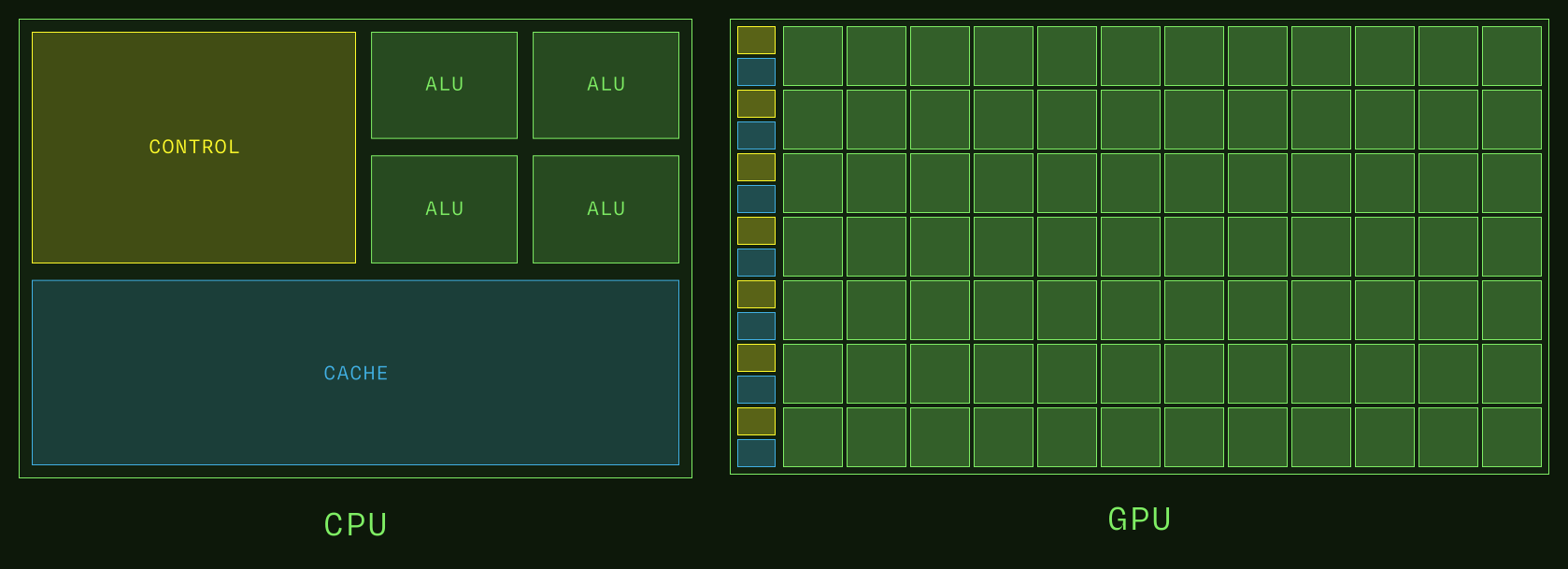
Figure adapted from the Modal GPU Glossary.
GPU instructions are carried out by streaming multiprocessors (SMs).
An SM in NVIDIA is analogous to a CPU core. SMs execute computation and store state for computation in registers and caches.
Streaming Multiprocessor Architecture
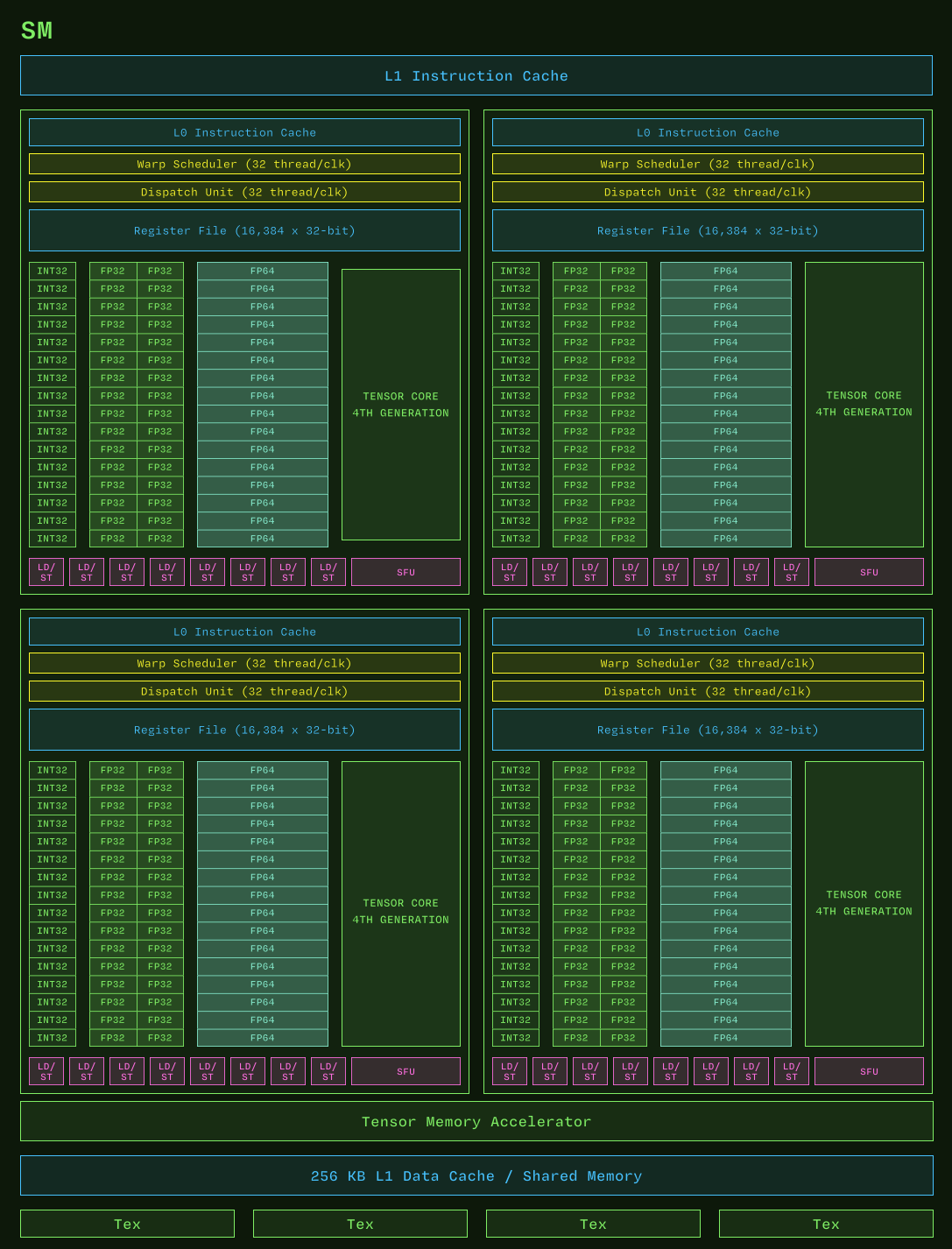
Figure adapted from the Modal GPU Glossary.
GPU Core Concepts
- GPU cores are the primary compute units of SMs.
- GPU cores are Tensor Cores and CUDA Cores.
- A GPU core is not analogous to a CPU core.
- Consider GPU cores as pipes. Data goes in and transformed data comes out.
- SFU stands for Special Function Unit. It accelerates certain math functions such as
exp,sin, andcos. - LSU stands for Load/Store Unit. It dispatches requests to load and store data to GPU memory subsystems.
- LSUs interact with L1 data cache and global RAM indirectly.
- A warp is a group of threads that execute on the same clock cycle.
- The warp scheduler decides which group of threads executes on each clock cycle.
- CUDA Cores execute scalar arithmetic operations.
- Tensor Cores execute matrix operations.
- Groups of CUDA Cores are given the same instruction simultaneously, but the instruction is applied to different registers and data.
- Tensor Memory Accelerators (TMAs) are specialised hardware in Hopper and Blackwell to accelerate access to multidimensional arrays.
- A Texture Processing Cluster (TPC) is a pair of adjacent SMs.
Memory Registers
- The register file is the primary store of bits in between manipulation by the cores.
- Analogous to CPU registers in terms of speed.
- It is split into 32-bit registers and can be allocated to different data types.
- L1 data cache is the private memory of an SM.
- It is accessed by LD/ST units of an SM.
- This cache is programmer-managed.
- Tensor Memory is specialised memory for storing inputs and outputs of Tensor Cores. It is only available in certain GPUs.
- GPU RAM is the global memory of a GPU. It can be either High Bandwidth Memory (HBM) or Double Data Rate (DDR) memory.
Normal Data Flow and TMA Data Flow
Normal data flow
HBM / global memory
        ↓
       L2
        ↓
Load/store pipeline per thread register
        ↓
Load/store pipeline
        ↓
Shared memory
        ↓
Registers used for computation
        ↓
FP32 / Tensor Core
TMA data flow
HBM / global memory
        ↓
       L2
        ↓
      TMA
        ↓
Shared memory
        ↓
Registers used for computation
        ↓
FP32 / Tensor Core
Each thread has to calculate the memory address in global memory and then bring it to shared/L1 cache.
For data shared across threads, data has to be moved to shared memory.
GPU Software Blocks
Cores, Threads and Warps
- Parallel Thread Execution (PTX) is an intermediate representation for code that runs on a CUDA device.
- Streaming Assembly (SASS) is the assembly format that runs on CUDA devices.
- Compute Capability is a versioning system that tells us what instructions can run on which CUDA device.
- A thread is the lowest unit of execution for a GPU.
- A single CUDA Core executes instructions for a single thread.
- A thread has its own registers.
- A warp is a group of threads that are scheduled together and execute in parallel.
- All threads in a warp are scheduled on the same SM.
- An SM normally executes multiple warps simultaneously.
- A warp group is a set of four contiguous warps.
- The entire set of four warps executes the same instruction. This is helpful for large matrix multiplications and is only present on Hopper architecture.
Cooperative Thread Arrays
- A Cooperative Thread Array (CTA) is a collection of threads scheduled to the same SM.
- It is a lower level term for a thread block.
- A CTA can have many warp groups.
- Threads in the same CTA can coordinate with each other, but threads not in the same CTA coordinate through global memory.
Thread Hierarchy
- A kernel is a typical unit of CUDA code, similar to functions in other languages for CPUs.
- A kernel is called or launched once and is executed many times, once by each thread.
- In CUDA C++, kernels take no parameters and return no value.
- A grid is a collection of blocks.
- A block is a collection of threads.
Grid
└── Blocks
    └── Threads
- This is the typical kernel launch code
add<<1,4,256>>We can have one grid with four blocks, and each block has 256 threads.
Block 0 → SM 0
Block 1 → SM 1
Block 2 → SM 2
Block 3 → SM 3
Block 0 and 4 → SM 0
Block 1 and 5 → SM 1
Block 2 and 6 → SM 2
Block 3 and 7 → SM 3
- Blocks have multiple warp groups.
- The blocks within a grid and threads within blocks can be arranged in one-, two-, or three-dimensional ways, such as
(1, 256)or(16, 16). - Dimensions are for programming convenience.
- Blocks and grids are part of the programming model, while CTAs are a lower-level PTX representation.
Memory Hierarchy
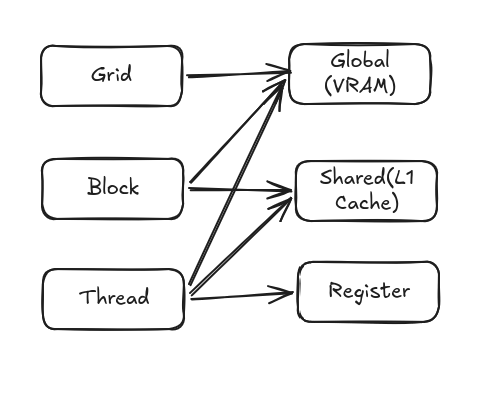
- Registers hold information manipulated by a single thread and are normally stored in the register file of an SM.
- L1 data cache holds data and information for a limited block in an SM. This is also called shared memory.
- GPU VRAM is called global memory. It is accessible to all threads. All input during grid launch is placed here.
References
- Modal, GPU Glossary.